Eukaryotic genomes transcribe a vast repertoire of RNA molecules, including protein-coding messenger RNAs (mRNAs) and regulatory non-coding RNAs (ncRNAs). ncRNAs can either reside at their own transcription loci or be recruited to other genomic regions, where they exert transcriptional regulatory functions by remodeling chromatin conformation and modulating DNA methylation and histone modifications.
For nearly seven decades since the formulation of the central dogma of molecular biology, mRNAs have long been regarded merely as messengers that transmit genetic information from genes to proteins. Most existing studies have focused on their canonical protein-coding functions, while their regulatory roles beyond protein synthesis remain largely unexplored.
On Oct. 15, 2026, the research team led by Dr. Yijun Qi from Tsinghua-Peking Center for Life Sciences published a study entitled Regulation of target gene expression by chromatin-associated protein-coding transcripts in plants in Science (1). This study, for the first time, reveals a novel protein-independent regulatory mode by which mRNAs modulate target gene transcription through chromatin association.
Previously, Dr. Qi’s team genome-widely characterized RNA-chromatin interactions in the model plant Arabidopsis thaliana, and discovered that numerous protein-coding mRNAs bind not only to their own transcription loci but also to additional chromatin regions across the genome. These findings suggested that mRNAs may function analogously to ncRNAs to regulate the expression of their target genes (2).
In the latest study, the team systematically analyzed 10,479 mRNA-mediated chromatin interactions in Arabidopsis, and found that approximately 12% of these interactions occur at genomic regions more than 5 kilobases (Kb) away from the transcription sites. To explore whether these mRNAs regulate the expression of their interacting genes, the team selected BT2 mRNA, which targets the genes CEP2 and MRF4, as a model for in-depth functional investigation.
Transcriptional levels of CEP2 and MRF4 were found to be significantly upregulated in bt2 mutants, indicating that BT2 represses the transcription of these two target genes. CEP2 is known to positively regulate primary root elongation, whereas MRF4 functions as a flowering repressor. Consistent with the elevated expression of CEP2 and MRF4, bt2 mutants exhibited elongated primary roots and delayed flowering. Further genetic analyses demonstrated that these two phenotypic alterations are specifically attributed to the derepression of CEP2 and MRF4, respectively. Collectively, these results indicate that BT2 modulates root growth and flowering time by repressing the transcription of CEP2 and MRF4.
To determine whether the observed regulatory effects rely on BT2 protein or BT2 mRNA, the team first performed genetic complementation assays. Ectopic expression of BT2 protein in bt2 mutants successfully restored the protein’s canonical function of hydrogen peroxide tolerance but failed to restore the repression of CEP2 and MRF4. Moreover, ectopically produced BT2 mRNA was unable to bind its target genes. These results indicate that BT2 protein is not involved in the regulation of CEP2 and MRF4. The team further generated nonsense and frameshift bt2 mutants via CRISPR/Cas9 editing. These mutants exhibited complete loss of BT2 protein function but maintained normal BT2 mRNA abundance. Notably, the expression levels of CEP2 and MRF4, as well as root length and flowering time, were indistinguishable from wild-type plants. These findings confirm that BT2 mRNA, rather than its encoded protein, controls the expression of CEP2 and MRF4.
The team next explored how BT2 mRNA specifically recognizes and regulates its target genes. After ruling out potential contributions of small RNAs, DNA methylation, chromatin spatial proximity, and phase separation, combined in vivo and in vitro assays verified that BT2 mRNA specifically binds to CEP2 and MRF4 by forming RNA-DNA triplexes via Hoogsteen base pairing. Through bioinformatic prediction combined with biochemical assays including electrophoretic mobility shift assay (EMSA) and microscale thermophoresis (MST), the team identified an AG-rich triplex-forming oligonucleotide (TFO) sequence within BT2 mRNA that mediates triplex formation. CRISPR/Cas9-mediated deletion of this TFO sequence in the BT2 locus did not alter the expression levels or canonical protein function of BT2, but completely abolished the chromatin binding capacity of BT2 mRNA. This ablation led to elevated expression of CEP2 and MRF4, accompanied by elongated primary roots and delayed flowering phenotypes. Further mechanistic analyses revealed that the RNA-DNA triplexes formed by BT2 mRNA facilitate the accumulation of repressive histone modifications H3K9me2 and H3K27me3 at target loci, thereby suppressing the transcription of CEP2 and MRF4 (Figure 1).
To validate the generality of mRNA-mediated transcriptional regulation, the team characterized the regulatory function of another mRNA, GSL8. GSL8 mRNA binds to and transcriptionally represses multiple target genes including MAT3. Consistent with the regulatory mode of BT2 mRNA, genetic complementation and frameshift mutant analyses confirmed that the transcriptional repression exerted by GSL8 is strictly dependent on its mRNA transcript, independent of its encoded protein. Distinct from BT2 mRNA, GSL8 mRNA does not form RNA-DNA triplexes with target DNA. Instead, it represses target gene transcription by restricting the deposition of activating histone modifications H3K4me2 and H3K36me3 at target loci (Figure 1). These findings demonstrate that different mRNAs employ distinct rather than universal mechanisms to regulate gene expression.
This study changes the conventional understanding of mRNA. Traditionally viewed merely as a “messenger” that transfers genetic information from DNA to proteins, mRNA has now been found to directly participate in the regulation of gene expression. Notably, the association of mRNA with chromosomes has been observed in cells of rice, mice, Drosophila, and even humans, suggesting that this regulatory strategy may be widely conserved across eukaryotes. Meanwhile, numerous RNAs previously annotated as non-coding RNAs (ncRNAs) can bind to ribosomes and be translated into polypeptides with essential biological functions. These dual-functional RNAs, which possess both coding and regulatory capabilities, may represent evolutionary intermediate molecules bridging coding and non-coding RNA systems, offering novel insights into the evolutionary mechanisms and functional diversity of RNAs. Several critical scientific questions remain to be further explored. How many additional mRNAs harbor such secondary regulatory identities in living organisms? How do these dual-functional mRNAs precisely coordinate and balance their dual biological roles as genetic messengers and gene regulators?
Dr. Yijun Qi is the corresponding author of this study. Postdoctoral researchers Lu Han and Yuxiang Yuan are co-first authors, and doctoral student Yujie Liu and Assistant Researcher Dr. Yan Li also contributed to this work. The research was supported by Tsinghua-Peking Center for Life Sciences, National Natural Science Foundation of China and New Cornerstone Science Foundation.
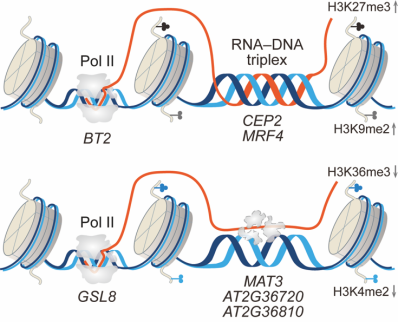
Figure 1. mRNA-mediated regulation of target gene expression The BT2 and GSL8 mRNAs possess intrinsic coding-independent activities that repress target gene transcription. BT2 mRNA forms RNA–DNA triplexes with its target loci, facilitating the enrichment of H3K9me2 and H3K27me3 to suppress transcription; while the GSL8 mRNA interacts with its target genes through a triplex-independent mode, hindering H3K4me2 and H3K36me3 deposition to downregulate target transcription.
Link to the paper: https://www.science.org/doi/10.1126/science.adz4903
References:
1. L. Han, Y. Yuan, Y. Liu, Y. Li, Y. Qi, Regulation of target gene expression by chromatin-associated protein-coding transcripts in plants. Science, 394, eadz4903 (2026). doi/10.1126/science.adz4903
2. L. Li, H. Luo, D. Lim, L. Han, Y. Li, X. Fu, Y. Qi, Global profiling of RNA-chromatin interactions reveals co-regulatory gene expression networks in Arabidopsis. Nat Plants 7, 1364-1378 (2021). doi: 10.1038/s41477-021-01004-x